
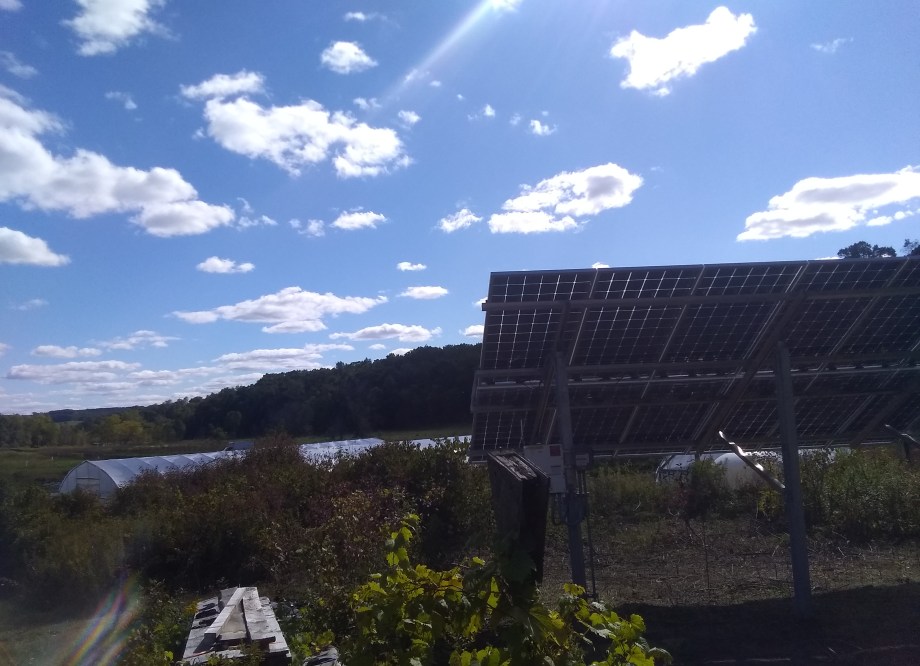
Solar works, in the sun
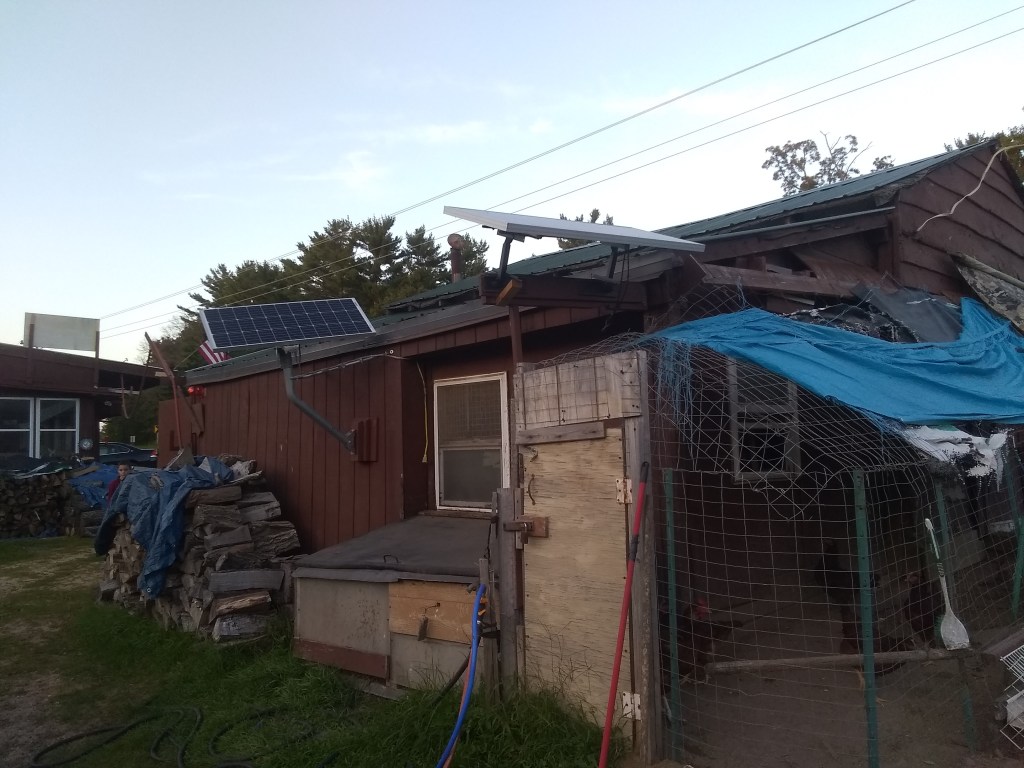
Use math to your advantage and plan ahead
In contrast, the solar setup worked very, very well in the summer, with good sun almost everyday. The system described could power the chicken light, a fan, and 4, 40 watt florescent bulbs without any problems. Don’t underestimate how much sun you will get in your area, and how much solar generation you need to fit your needs. It’s not worth having problems in 6 months when its winter and you need more power. Always know what you need, and add a little more room for flexibility. Here’s a good equation to follow if you are trying to figure out what you need for your system, you move backwards.
Equation to follow
As a rule of thumb, don’t let your amperage be over 80 amps in your system. The maximum wattage of a 12 volt system is around 900 watts, 1900 watts for 24 volts, and so on. This is for safety, and efficiency reasons.
Wattage of your appliances? – This will give you your inverter size, as well as gauge of wire for wiring up your batteries
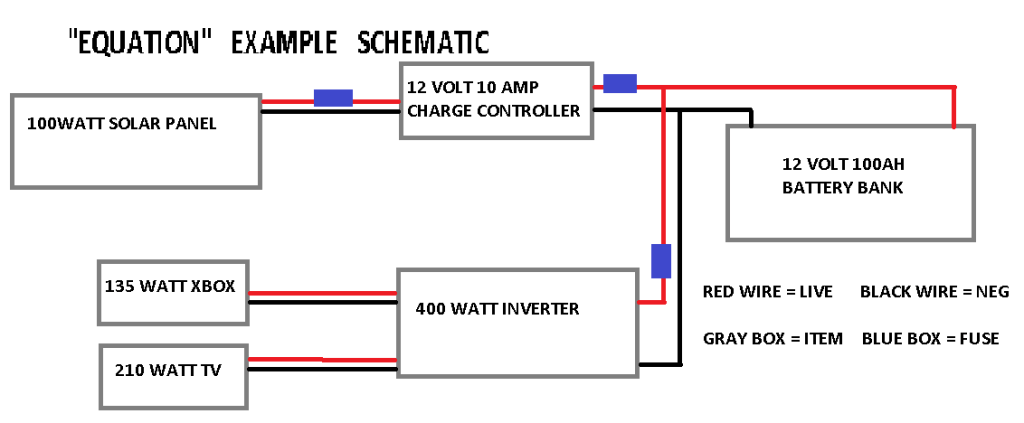
Let us say you want to run an 135 watt Xbox 360 and a 210 watt TV, I would round this to 150 and 250 just to have flexibility. To find out your inverter size, all you need to do is add them together, 150 watts + 250 watts = 400 watts. A 400 watt inverter is adequate for this system. On a side note, there are two different kinds of inverters, Pure Sign Wave and Modified Sine Wave. Some people recommend pure sign wave for all complex electronics like computers/radios/consoles, though in my experience I have ran these electronics just fine off of modified sign wave inverters. You should use pure sign wave inverters for complex health machinery, and some inductive loads. Do your own research here to find which best suits your situation. As for the wire gauge, 400watts/ 12volts = 33amps. You would then use 10 gauge wires to wire up your batteries, because at max capacity you will be drawing 33 amps from the battery bank.
X wattage for how long, and how often? – This will give you your overall battery AH size, as well as how much time you give the battery to charge
Lets say you want to run your xbox and tv for 3 hours at a time, once a week. So realistically, your drawing 350 watts from a 12 volt battery at a time. This means your drawing about 30 amps an hour from your battery. In order to play for 3 hours, you would need a 90 amp hour battery at 12 volts. Since you only want to play once a week, you give your batteries roughly 6.5 days to charge.
How much sun do you get per day? – This will tell you how many solar panels or overall solar panel wattage you need to charge the battery bank.
Lets say you live in an equator like environment with full sun 8 hours a day. One 100 watt solar panel will put out in these conditions 800 watts a day. Specifically, the panel will put out ideally 66 amps a day. 100 watts * 8 hours of sun = 800 watts, 800 watts divided by 12 volts equal 66 amps. To help save costs you can either use those batteries every 2 days, or just get a smaller panel. In this situation, you would only need one 100 watt solar panel.
You now will know what gauge wire you need for your system. Find out how much you need in length, and appropriate sized fuses/breakers for safety.
Since the solar panel in this equation will only be putting out 8 amps, or less. 14 gauge wire will be adequate. Wire the solar panels with 14 gauge wire into the charge controller, and then into the battery bank. Since 14 gauge wire is adequate up to 15 amps, on the solar panels live wire you would ideally put a 15 amp breaker on the line to protect from fires/overheating. Since the batteries are wired in a 12 volt system, you would want a 14 volt, 30 amperage breaker between the charge controller and battery. You only want to charge/discharge lead acid batteries at a third of their capacity to keep them healthy. It’s not a necessity, but useful if you want your batteries to last longer. This gets more important on larger systems.
Now you know based on the amperage/voltage you decided on the panels array what kind of charge controller you need for the system. Decide whether PWM or MPPT charge controllers are best for your system.
Since we only have 8 amps coming in from the solar panel, we only need 12 volt 10 amp charge controller. Also, since the system is so small, we only need a PWM. MPPT charge controllers are mostly used when you don’t have a lot of sun, or large scale operations.
For safety precautions it is recommended that you fuse all of the electronics from each other to protect your investments. Between the solar panels and charge controller, charge controller and battery, and if you like between the inverter and battery. It should then look like this.
If you have anyquestions, leave them in the comment section and I can help to the best of my ability.
DISCLAIMER ON FIRST PAGE
 a place to connect